
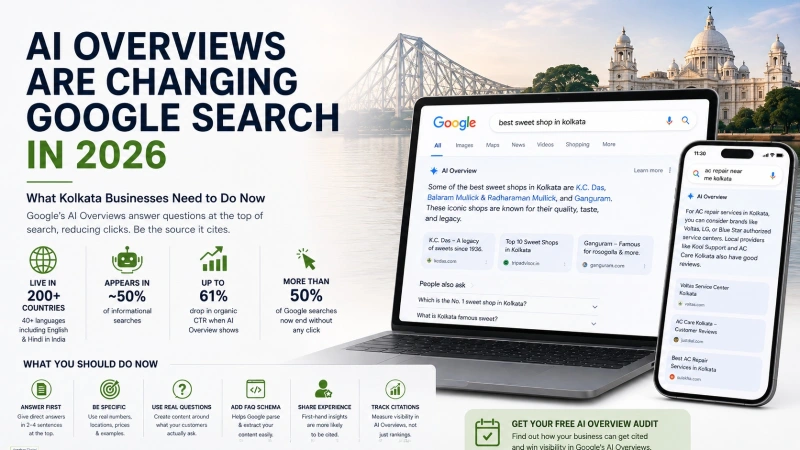
Your rankings haven’t moved. Your traffic has. If that’s the report you’re staring at, you’re not imagining things and you haven’t been penalised. Google is answering your customer’s question before they ever reach your website.
That’s AI Overviews. By 2026 it isn’t a test sitting off to one side of the results page — it’s the first thing most people see. For a business competing on “best biryani in Park Circus” or “AC repair Salt Lake,” this isn’t a trend to read about later. It already changed how customers find you.
What Are Google AI Overviews?
Google AI Overviews are AI-generated summaries that appear above traditional search results, pulling information from multiple websites into a single answer with citation links. Users read the summary, sometimes click a citation, and often stop there. Google launched them in the US in May 2024 and brought them to India within six months, with English and Hindi support from early on.
BrightEdge puts their presence at roughly 48% of tracked queries as of February 2026, up from about 31% a year earlier. India matters here specifically: Google reported AI Mode passed 100 million monthly active users across the US and India, and that query types showing AI Overviews saw a 10%+ increase in overall search usage in both markets.
Read that last number twice. Search volume is going up. Clicks to websites are going down. Those two facts together are the whole story.
What Changed in Google’s May 2026 AI Overviews Update?
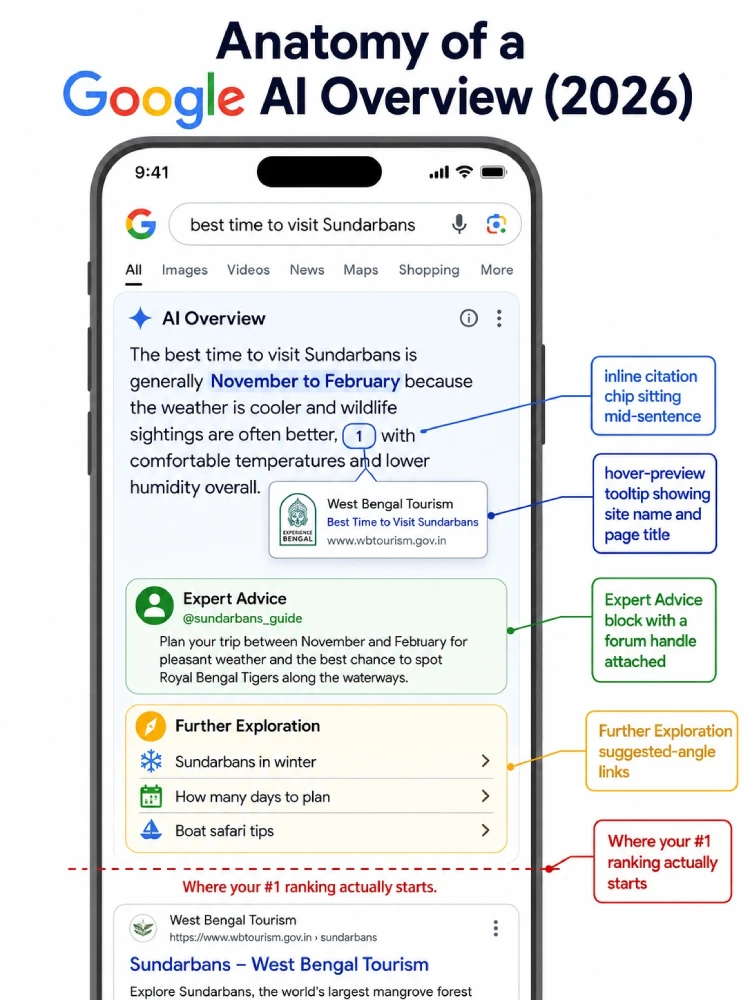
On 6 May 2026, Google shipped five structural changes to AI Overviews and AI Mode — the largest update since the feature launched. Google framed them as ways to send more traffic to publishers. In practice, they raise the reward for being cited and lower the reward for simply ranking well.
| Change | What it does | Why it matters to you |
|---|---|---|
| Inline citations | Links sit beside the exact sentence they support, not in a footnote panel | Passage-level relevance now beats page-level relevance |
| Hover previews | Desktop users see the site name and page title before clicking | Recognisable brand names win the click |
| Expert Advice block | Pulls first-hand quotes from forums, reviews and social, with the handle shown | Your reviews and community posts can become citations |
| Suggested angles | Links to in-depth articles on facets of the topic | Deep topic clusters earn a placement that thin pages can’t |
| Subscription labels | Flags links from publications the user subscribes to | Mostly a publisher story, not a local business one |
Two of these five genuinely change how you should write. Inline citations mean a single well-phrased sentence can earn a link even if the rest of the page is unremarkable. Suggested angles reward businesses that cover a topic properly instead of publishing one shallow page and moving on.
Which change do most local businesses underestimate?
The Expert Advice block. It surfaces quotes from real people with real experience — Reddit threads, review platforms, public discussions — and attaches a name or community handle. A Gariahat shop owner answering a question honestly in a local Facebook group is now competing for the same space as a national brand’s content team. That’s a rare structural advantage for small businesses, and almost nobody is using it deliberately.
How Much Traffic Are AI Overviews Actually Costing You?
Organic click-through rates fall sharply on searches where an AI Overview appears — studies measure the drop at between 47% and 61% depending on methodology. The numbers differ because the studies measure different things, so treat them as a range, not a single verdict.
| Study | Finding | Sample |
|---|---|---|
| Seer Interactive (Sept 2025) | Organic CTR fell from 1.76% to 0.61% — a 61% drop | Multi-brand tracking study |
| Ahrefs (2025) | Position-1 CTR fell from 1.41% to 0.64% | 300,000 keywords |
| Pew Research Center (Mar 2025) | Click rate 8% with an AI Overview vs 15% without | Browsing data, 900 US adults |
Is the decline still getting worse?
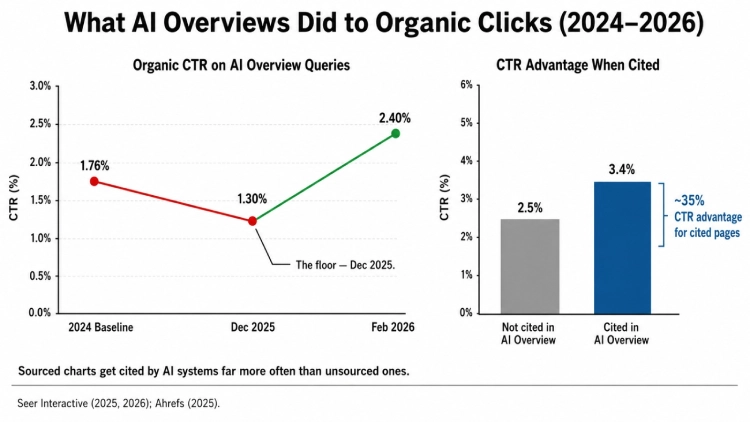
Not necessarily, and this is the part most articles leave out. Seer Interactive’s 2026 update — covering roughly 53 brands and 5.47 million tracked queries — found organic CTR on AI Overview queries rebounded from a floor of 1.3% in December 2025 to 2.4% by February 2026. The floor may already be behind us.
There’s a second number worth knowing: Ahrefs found that pages cited inside an AI Overview see roughly 35% higher organic CTR than pages that aren’t cited. Being quoted isn’t a consolation prize for losing the click. It’s the new position one.
Why This Hits Local Kolkata Businesses Differently?
There’s a comfortable assumption that this is a publisher problem, not a problem for a tailor in Park Circus or a clinic in Ballygunge. It’s half right, and the wrong half is expensive.
Local and transactional searches trigger AI Overviews far less often than informational ones. NP Digital’s analysis of eight million queries across 38 countries found health, home improvement and transport topics generate Overviews most frequently, while real estate, automotive and local services show much lower rates. Someone searching “book a photographer in Kolkata” still sees a normal results page more often than someone searching “how much does wedding photography cost.”
That gap is your window, and it’s closing as Google extends AI Overviews into commercial queries.
The practical read: your blog content is taking the hit now, while your service and location pages stay relatively protected. That argues for strengthening your local SEO and Google Business Profile foundations while you adapt your content — not for abandoning content. If your profile isn’t surfacing at all, start with our guide on why your Google Business Profile isn’t ranking in Kolkata searches.
Sector matters too. A healthcare practice in Salt Lake is far more exposed than a real estate agency, because health queries trigger AI Overviews at some of the highest rates of any category.
AEO vs GEO vs SEO: What’s the Difference?
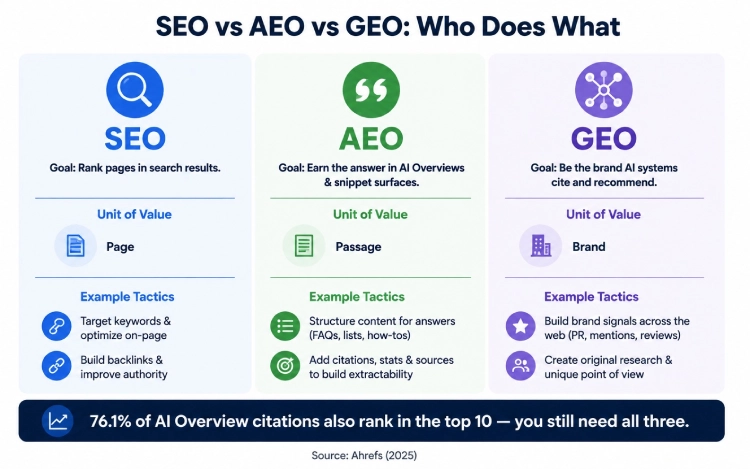
SEO gets you ranked, AEO gets you quoted, and GEO gets your brand mentioned across AI platforms. They overlap heavily and you need all three — but they’re optimised for differently.
| SEO | AEO | GEO | |
|---|---|---|---|
| Full name | Search Engine Optimisation | Answer Engine Optimisation | Generative Engine Optimisation |
| Goal | Rank in the blue links | Get quoted in the answer box or AI Overview | Get named across ChatGPT, Perplexity, Gemini, AI Mode |
| Unit of value | The page | The passage | The brand entity |
| Key tactic | Keywords, links, technical health | Extractable 2–4 sentence answers, schema | Consistent facts across the web, third-party mentions |
| Measured by | Rankings, sessions | Citations, featured snippets | Share of voice in AI answers |
Here’s the reassuring part: Ahrefs found that 76.1% of URLs cited in AI Overviews also rank in Google’s top 10. Classic SEO isn’t dead — it’s the entry ticket. AEO decides who gets quoted once you’re through the door. Our SEO services now build AEO and GEO into the same workflow for exactly this reason, because splitting them into separate projects wastes budget on both.
How Can a Kolkata Business Get Cited in AI Overviews?
Getting cited requires content structured for extraction: a direct answer near the top, specific verifiable details, question-shaped headings, valid schema, and genuine first-hand experience under a named author. Here’s the working checklist.
1. Answer the question first, then explain it
AI Overviews pull short, self-contained answers — typically two to four sentences that directly address the question. If your useful paragraph sits three scrolls down beneath a warm-up introduction, the summariser has less to work with. Put the answer at the top. Expand underneath.
2. Trade polish for specificity
“We offer quality catering services” gives an AI nothing to quote. “We cater Bengali wedding functions for 200 to 800 guests across South Kolkata, with fixed per-plate pricing from ₹450” gives it something concrete. Numbers, place names, ranges and constraints are what make a sentence extractable. Vagueness is the single most common reason good local content never gets cited.
3. Structure pages around questions customers actually ask
Headings phrased as real questions outperform clever marketing headlines here. If people keep asking “how much does a wedding photographer cost in Kolkata,” that should be an H2 on your site, answered plainly in the first two sentences beneath it — not buried in a downloadable brochure. Pull these questions from your WhatsApp enquiries and call logs. That’s free keyword research your competitors don’t have.
4. Add FAQPage and LocalBusiness schema
Structured data doesn’t guarantee a citation, but it makes your content dramatically easier to parse and lift. For local businesses, LocalBusiness schema with accurate NAP details, service areas and opening hours does double duty across both AI Overviews and the local pack. If your site is on a theme that mangles structured data, that’s a website development problem worth fixing before you write another blog post.
5. Publish first-hand experience under a real name
The Expert Advice block explicitly rewards lived experience. “In fifteen years of running this shop, the mistake we see most often is…” carries weight that a rewritten industry summary never will. Name your author, add a bio, add Person schema. Anonymous content is a weak citation candidate in 2026.
6. Show up in the places the Expert Advice block reads
This block pulls from forums, review platforms and public discussions — so your Google reviews, your answers in local Facebook groups and relevant Reddit threads are now potential citation sources. Contribute genuinely rather than marketing to people. The block quotes people who sound like they know the answer, not people who sound like an advert.
7. Keep it fresh
A page published in 2024 carrying 2024 statistics is competing against pages updated last month. Set a quarterly review on your top ten pages and actually update the numbers. Our content marketing services treat refresh cycles as scheduled work, because publish-and-forget is what kills most local blogs.
8. Change what you measure
Ranking #1 means less when an AI Overview answers the question above you. Track whether you’re being cited for your priority queries — search them manually every month if you have no tooling — alongside branded search volume, direct traffic and actual enquiries. Rankings are now a leading indicator, not the outcome.
What Should You Measure Now That Rankings Mean Less?
Google Search Console does not cleanly separate AI Overview clicks from ordinary organic clicks, so you can’t simply pull a report. Build your view from proxies instead:
- Impressions vs clicks divergence. Steady impressions with falling clicks is the signature of AI Overview pressure on that query set.
- Branded search volume. If AI answers mention you, people search your name afterwards — the cleanest available signal that GEO is working.
- Direct traffic and enquiry volume. People who read your name in an AI answer often arrive with no referrer.
- Manual citation checks. Run your ten priority queries monthly and record whether you appear. Unglamorous, but it works.
If clicks are falling faster than you can adapt your content, paid search is a reasonable bridge while the organic work compounds — we’ve broken down that trade-off in SEO vs Google Ads for a new Kolkata business.
The Bigger Shift: From Ranking to Being Quoted
This isn’t a dip that reverses. Google described its 2026 Search changes as among the largest overhauls in two decades, and the direction is consistently toward more AI-driven, conversational search.
Fewer clicks per search is the new baseline. But the business that gets named inside the answer captures something a blue link never gave you: the customer arrives already told, by Google, that you’re the answer. That’s a warmer lead than any position-one click ever was.
For Kolkata businesses, the goal is no longer to rank. It’s to become the source Google’s AI trusts enough to quote by name. That takes specific, well-structured, genuinely experienced content — not more of it.
Want to know where you currently stand? Get a free website audit and we’ll show you which of your pages are AI-citation ready and which are invisible. Delivered in 24 hours, no sales call required. You can also review our transparent SEO pricing or explore our AI marketing services built specifically for AEO and GEO.
Frequently Asked Questions
What are Google AI Overviews?
AI Overviews are AI-generated summaries that appear above traditional search results, combining information from multiple sources into one answer with citation links. They appeared on roughly 48% of tracked queries as of February 2026, according to BrightEdge.
Are AI Overviews live in India?
Yes. India was among the first markets outside the US to receive AI Overviews, in mid-2024, with English and Hindi support. Google has reported that AI Mode surpassed 100 million monthly active users across the US and India.
Do AI Overviews reduce traffic for every business equally?
No. Informational searches are affected most heavily. Local and transactional searches — where someone is ready to book or buy — trigger AI Overviews far less often, though that gap is narrowing as Google expands coverage into commercial queries.
How do I get my business cited in an AI Overview?
Publish specific, first-hand content that answers a real customer question within the first two to four sentences under a question-shaped heading, mark it up with FAQPage and LocalBusiness schema, attribute it to a named author, and keep it updated quarterly.
What is the difference between AEO and GEO?
AEO (Answer Engine Optimisation) focuses on getting your content quoted inside answer boxes and AI Overviews. GEO (Generative Engine Optimisation) focuses on getting your brand mentioned across generative platforms like ChatGPT, Perplexity and Gemini. AEO optimises the passage; GEO optimises the brand entity.
Should you stop investing in SEO because of AI Overviews?
No. Ahrefs found 76.1% of URLs cited in AI Overviews also rank in Google’s top 10, so traditional SEO remains the entry requirement. What’s changed is that content must now be written for extraction and citation, not ranking alone.
Can you see AI Overview traffic in Google Search Console?
Not as a clean separate report. Search Console does not isolate AI Overview clicks from other organic clicks, so most businesses track proxies instead: divergence between impressions and clicks, branded search volume, direct traffic, and manual monthly citation checks.
How long does it take to start appearing in AI Overviews?
For an established site with existing rankings, restructured pages can begin earning citations within weeks of being recrawled. For newer sites the timeline follows normal SEO — several months — because a page generally needs to rank before it becomes a citation candidate.