
You’ve heard Google Ads can bring in leads fast. You’ve also heard it can burn through cash with nothing to show for it. Both are true — the difference usually comes down to one number: your budget. Get it too low and you never leave the algorithm’s learning phase. Get it right and you know exactly what a lead costs you before you spend a rupee more.
How Much Do Google Ads Actually Cost in India?
Most Indian businesses pay somewhere between ₹5 and ₹150 per click, with the national average sitting around ₹25–₹30. That’s the honest, unglamorous answer — and it’s also useless on its own, because your industry decides where in that range you land. A local tiffin service and a home loan broker are not bidding in the same market, even if they’re both in Kolkata.
Search ads cost more than Display because the person searching is closer to buying. Someone typing “book baker North Kolkata” is ready to hand over money. Someone scrolling Instagram and seeing your banner isn’t — yet. That gap in intent is why Search CPCs run higher, and why most small businesses should start there rather than spreading a thin budget across every ad format Google offers.
What Should a Small Business Actually Budget?
₹20,000–₹30,000 a month is where Google Ads starts behaving like a real growth channel instead of a coin flip. Below that, you can still run ads — plenty of local businesses do it on ₹5,000–₹10,000 a month — but you’re working with a tighter net: fewer keywords, one city, one offer, no room for testing.
| Monthly Budget | Approx. Clicks (₹30 CPC) | Realistic For |
| ₹5,000–10,000 | 165–330 | One hyper-local service, single keyword cluster |
| ₹15,000–25,000 | 500–830 | Local business ready to test 2–3 offers |
| ₹30,000–75,000 | 1,000–2,500 | Regional business scaling across cities |
| ₹1,00,000+ | 3,300+ | Multi-location or high-ticket B2B |
These numbers assume a mid-range CPC. If you’re in insurance or legal services, cut the click count by half or more — you’ll see why below.
The Formula That Actually Tells You What to Spend
Forget “how much should I budget” as a standalone question. Answer this instead:
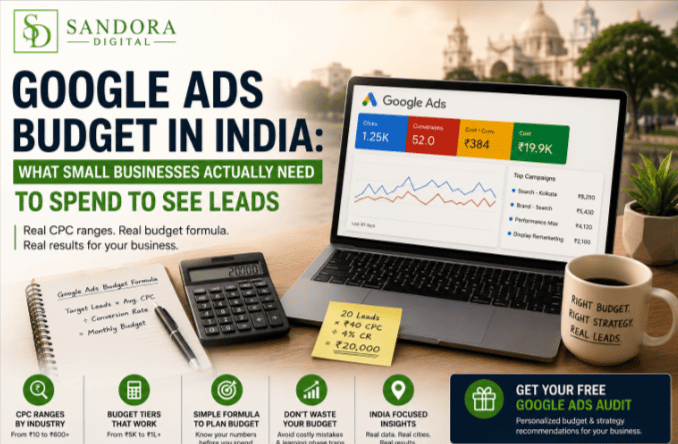
Monthly budget = Target leads × Average CPC × (1 ÷ Landing page conversion rate)
Say you want 20 leads a month, your industry’s average CPC is ₹40, and your landing page converts at 4%. That’s 20 × 40 × 25 = ₹20,000. Don’t know your conversion rate yet? Use 2–3% for service businesses and 1–2% for e-commerce as a starting estimate, then correct it with real data after 30 days.
This formula does something most “budget guides” skip: it forces you to have a landing page and a conversion number before you touch the ad account. If you can’t fill in those blanks, that’s the actual problem — not your budget size.
CPC by Industry: Where Your Money Actually Goes
| Industry | Typical CPC Range |
| Restaurants & local food | ₹10–₹25 |
| E-commerce & retail | ₹15–₹40 |
| Education & coaching | ₹10–₹50 |
| Healthcare & clinics | ₹30–₹80 |
| Real estate | ₹40–₹120 |
| SaaS & B2B tech | ₹100–₹300 |
| Legal, finance & insurance | ₹100–₹600+ |
That last row is worth sitting with. A single click for a health insurance keyword can cost more than an entire day’s budget for a local bakery. If you’re in a high-CPC category, the fix isn’t a bigger budget by default — it’s tighter targeting, exact-match keywords, and a landing page built to convert cold clicks fast, because every one of them is expensive.
Ad Spend and Management Fees Are Two Different Bills
This trips up a lot of first-time advertisers: the money you pay Google for clicks and the fee you pay whoever manages the account are separate line items. Google takes the ad spend directly. The management fee — typically ₹10,000–₹75,000 a month, or 10–20% of spend — goes to the person or agency running strategy, bidding, and optimisation.
Ask any agency to itemise both before you sign anything. If a quote lumps “total marketing cost” into one number without separating platform spend from management fees, you can’t tell what you’re actually paying for performance versus paying for someone’s time.
The Mistake That Wastes the Most Budget
Starting too small and stopping too soon. Google Ads needs volume — usually around 15 conversions per campaign — before its bidding algorithm has enough data to stop guessing and start optimising properly. A budget so tight it can’t generate that volume in 4–6 weeks keeps the account permanently in “learning mode,” where cost per lead stays high because Google never gets a clear signal of what a good customer looks like for you.
If ₹20,000 a month feels like a stretch, it’s often better to run a tightly scoped campaign — one city, one service, five keywords — at a workable daily budget than to spread ₹10,000 across five services and never let any of them gather enough data to improve.
When Google Ads Isn’t Worth Spending On Yet
Not every business should switch on Google Ads this month. Skip it, at least for now, if you don’t have a landing page that loads fast and states one clear offer, if you have no way to track what happens after the click (calls, form fills, WhatsApp messages), or if your margins can’t absorb a few weeks of learning-phase costs while the algorithm calibrates. Fix those three things first. Ads amplify whatever you already have — a strong funnel gets stronger, a broken one just gets more expensive to run.
If clicks are dropping faster than your organic content can catch up, Google Ads can provide a practical short-term bridge while your SEO efforts build momentum. We’ve explained the key trade-offs in our guide to SEO vs Google Ads for a new Kolkata business.
FAQs
Is ₹5,000 a month enough to run Google Ads in India?
It’s enough to get started for a single, hyper-local service with low CPC, but expect limited data and slower optimisation. Most businesses see better cost-per-lead once they cross ₹15,000–₹20,000 a month.
Why do Google Ads cost more in some Indian cities than others?
Competition drives price. Metro markets like Kolkata, Mumbai, Bengaluru, and Delhi NCR generally see higher CPCs than tier-2 cities because more advertisers are bidding for the same searches.
Do I need a separate budget for Search and Display ads?
Yes, ideally. Search ads target people actively looking to buy and should get the bulk of a small business’s early budget. Display works better for brand awareness once Search is already converting.
How long before Google Ads starts generating consistent leads?
Most accounts need 4–6 weeks and a reasonable conversion volume to exit the learning phase. Expect the first two weeks to be more expensive per lead than months two and three.
What’s the difference between ad spend and an agency’s management fee?
Ad spend goes to Google for clicks and impressions. The management fee goes to whoever is running the account and is a separate cost, typically ₹10,000–₹75,000 per month or 10–20% of spend.
Should I manage Google Ads myself or hire an agency?
DIY works if you have time to learn the platform and monitor it weekly. An agency makes more sense once your budget crosses ₹25,000–₹30,000 per month, where mistakes get expensive fast and optimisation time has real ROI.
Get a Straight Answer on Your Budget
There’s no universal number, but there is a right number for your industry, city, and goals — and it’s usually smaller than agencies want you to believe and bigger than a ₹5,000 experiment can prove. If you want that number for your business specifically, Sandora Digital’s free audit includes a Google Ads budget recommendation based on your actual industry and market, delivered within 24 hours.