
Somebody promised you page-one rankings in 30 days. They were either wrong or lying, and either way, you’re going to be disappointed a month from now when nothing has changed.
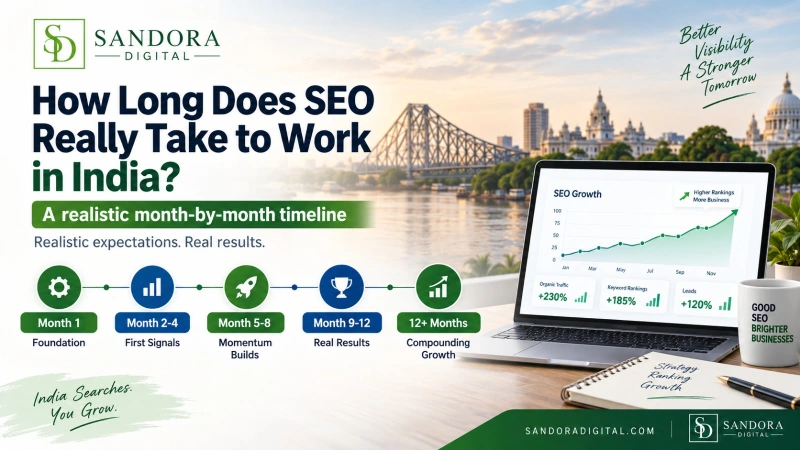
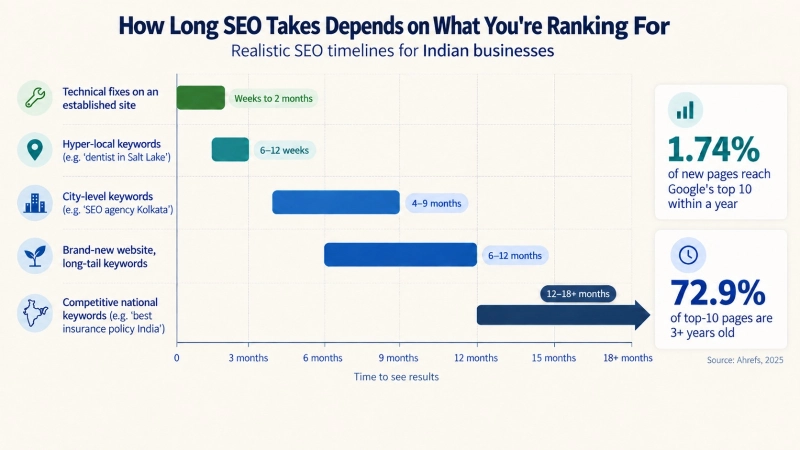
SEO in India typically takes 3 to 6 months to show the first measurable signals and 6 to 12 months to deliver consistent leads and revenue. Hyper-local and long-tail keywords can move within 6–12 weeks, while competitive national keywords often need 12–18 months.Google’s own guidance puts the typical window at four months to a year.
That range isn’t an agency dodging commitment. It’s what actually happens when a website competes for attention in a country with 958 million active internet users, where Google handles more than 97% of all searches. This guide walks through each phase, what you should realistically measure, how the timeline changes for different kinds of businesses, and why AI search has quietly moved the finish line.
Key Takeaways
- Expect first signals in 3–4 months (impressions and long-tail rankings), not traffic spikes.
- Expect business results in 6–12 months: steady leads, organic revenue and stable rankings.
- Local keywords move fastest because city-level competition is thinner than national competition.
- Competitive national terms take 12–18 months or longer, especially for newer websites.
- In 2026, “SEO working” also means being cited in Google’s AI Overviews, not just ranking below them.
Why Doesn’t SEO Work Instantly?
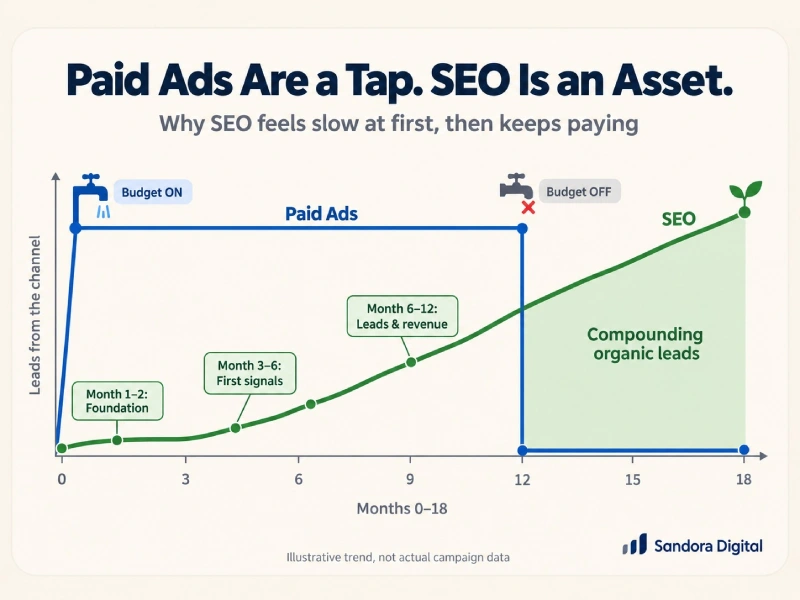
Paid ads work like a tap. Turn it on, traffic flows; turn it off, it stops. SEO doesn’t work that way because you’re not buying placement; you’re earning trust. Google has to crawl your pages, index them, watch how people interact with them, and compare your site against every competitor already sitting in that spot. None of that happens on your schedule.
The data backs this up. A 2025 Ahrefs study found that only 1.74% of newly published pages reached Google’s top 10 within a year, and the average page ranking at position one was about five years old. Older pages have had time to collect links, engagement signals and topical depth. New pages have to earn the same.
That’s slower than most business owners want, but it’s also why SEO compounds instead of evaporating. An ad stops working the day you stop paying for it. A well-ranked page you published eighteen months ago can still be pulling in leads today without you touching it. If you’re weighing both channels right now, our breakdown of SEO vs Google Ads for a new business explains which one to start with.
SEO Timeline in India at a Glance
Here’s the full journey in one view. Use it to judge progress at the right stage instead of the wrong one.
| Phase | What happens | What to measure | Realistic outcome |
|---|---|---|---|
| Month 1–2 | Technical audit, keyword research, Google Business Profile, tracking setup | Errors fixed, pages indexed | Groundwork, little traffic |
| Month 3–4 | New pages indexed, long-tail and local terms move | Impressions, positions 20–50 | First real signals |
| Month 5–6 | Rankings climb, earned links start counting | Top 10–20 rankings, organic sessions | Visible momentum |
| Month 6–12 | Consistent traffic and enquiries | Leads, organic revenue, AI citations | Business impact |
| Month 12–18+ | Competitive national keywords | Share of voice versus competitors | Category leadership |
Month 1–2: What Happens in the First 60 Days of SEO?
Nothing you do in the first eight weeks should be judged by traffic numbers, because there won’t be any worth judging yet. This is where the real groundwork happens:
- Technical audit and fixes: broken links, slow load times, duplicate pages, poor mobile experience, and anything blocking Google from crawling your site. If the site itself is the bottleneck, a fast, SEO-ready website rebuild can save months later.
- Market-specific keyword research: not just what’s searched globally, but what people in Kolkata, Mumbai, Delhi or your own city actually type, including Hinglish and regional-language phrasing.
- Google Business Profile optimisation: this matters enormously for local Indian searches. Google/Ipsos research found people are 2.7 times more likely to consider a business reputable when its profile is complete, and 70% more likely to visit. That’s why our local SEO services start here.
- Tracking setup: Google Search Console and Google Analytics 4, so you have an honest baseline to measure against later.
You might see small movement, such as a jump in impressions as Google recrawls fixed pages, but this isn’t the phase to decide whether SEO is “working.”
Month 3–4: What Are the First Real Signals That SEO Is Working?
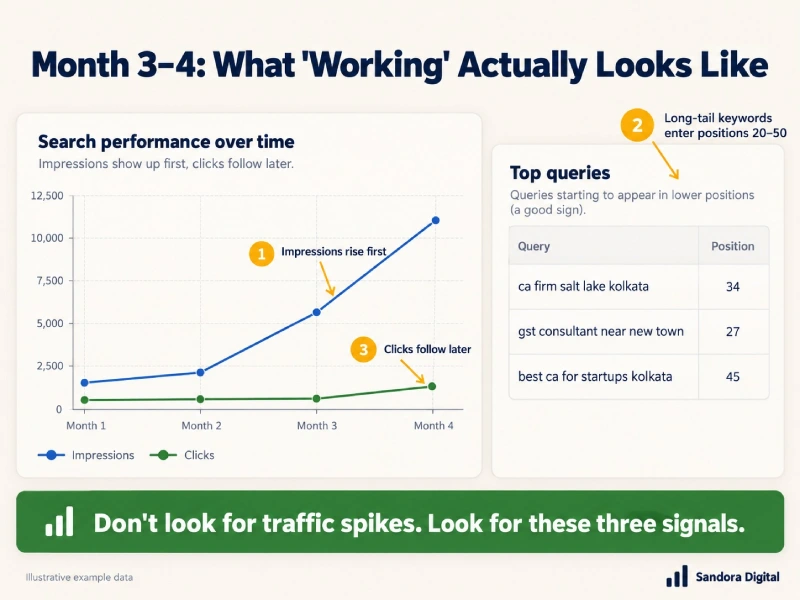
This is usually when the first genuine indicators appear, and it’s worth knowing what to look for, because it’s rarely a traffic spike. Open Search Console and check for:
- New pages getting indexed and starting to collect impressions
- Long-tail and local keywords breaking into positions 20–50, even if they’re not on page one yet
- A slow but visible rise in impressions before clicks catch up
If you’re targeting hyper-local terms like “best chartered accountant in Salt Lake” rather than “chartered accountant India,” this is often when you’ll see actual ranking movement. Local competition is thinner, and Google can establish trust faster on a narrower query.
Month 5–6: Why Do So Many SEO Campaigns Get Cancelled Here?
By now, if the foundational work was solid, you should see consistent (not dramatic) growth. Priority keywords start climbing into the top 10–20. Organic traffic is up, even if it’s not yet a headline number. Backlinks earned in months one to three begin carrying real weight, because link value builds gradually rather than overnight.
Honestly, this is the most dangerous stretch. The growth is real, but it doesn’t look impressive enough for someone who expected page-one results. This is exactly where campaigns get killed too early, often weeks before they would have paid off. If you need enquiries while SEO matures, run Google Ads alongside it instead of abandoning organic altogether.
Month 6–12: When Does SEO Start Generating Leads and Revenue?
Google’s Search Central documentation says businesses should typically expect four months to a year from the time changes begin until they see benefits. In practice, six to twelve months is when SEO starts producing results that matter: consistent lead flow, revenue you can attribute to organic search, and rankings that hold steady rather than swinging with every update.
Competitive, high-volume national keywords, think “best insurance policy India” or “digital marketing agency India,” will realistically sit at the far end of this window or past it. The same Ahrefs research found that 72.9% of pages in Google’s top 10 are more than three years old. If you’re in one of those crowded categories, plan for 12–18 months before you’re genuinely competitive, not six.
How Long Does SEO Take for Different Types of Businesses in India?
“It depends” is a frustrating answer, so here’s what it actually depends on.
Local Service Businesses
Clinics, coaching centres, CA firms, salons and restaurants competing in one city often see movement for low-competition local keywords within 6–12 weeks, driven largely by Google Business Profile and map pack rankings. Our guide to local SEO for coaching centres in Kolkata shows how this plays out.
Brand-New Websites
A new domain has no links, no history and no proof of expertise. Plan for 6–12 months before meaningful traffic, and focus year one on long-tail topics you can realistically win.
E-commerce Stores and National Brands
Category pages targeting broad national terms compete with marketplaces and established brands. Expect 12–18 months for head terms, with product and long-tail pages delivering earlier wins. See our approach to e-commerce digital marketing.
Established Websites With Technical Problems
If a site already has authority but is held back by crawl blocks, accidental noindex tags or broken redirects, fixing those issues can restore visibility within weeks. This is the one scenario where fast results are genuinely realistic.
What Speeds Up SEO Results (and What Doesn’t)?
What Genuinely Speeds It Up
- A technically clean, fast, mobile-friendly site from day one
- Genuinely useful content that answers real customer questions, backed by a consistent content marketing plan
- Targeting realistic local and long-tail terms before chasing broad national ones
- Links from relevant Indian publications, associations and industry sites rather than low-quality directories
What Doesn’t Speed It Up, No Matter What You’re Told
- Buying backlinks in bulk
- Publishing keyword-stuffed or mass-produced AI content
- Switching strategy every six weeks because month three didn’t look like month six
Google’s core updates punish exactly this kind of chasing. 2026 has already seen two broad ones, the March and May 2026 core updates, and both brought noticeable ranking volatility.
How Is AI Search Changing What “SEO Working” Means?
It’s worth saying plainly: even once your SEO “works,” the definition of working has shifted. A growing share of searches now get answered inside Google’s AI Overviews before anyone clicks.
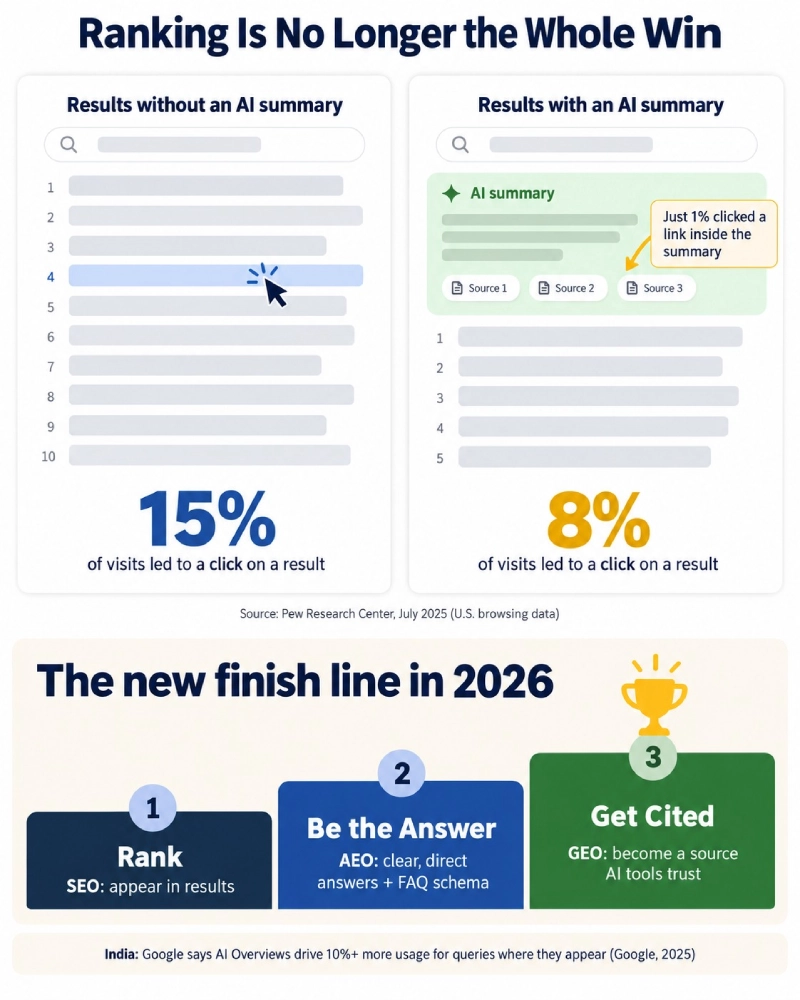
A Pew Research Center analysis of U.S. browsing data found users clicked a traditional search result on 8% of visits when an AI summary appeared, versus 15% when it didn’t. Only 1% of visits involved clicking a link inside the summary. Closer to home, Google reports that in its biggest markets, including India, AI Overviews are driving more than a 10% increase in usage for the queries where they appear.
So rising rankings don’t always mean proportionally rising traffic. That doesn’t mean SEO stopped working. It means the win now includes two newer disciplines:
- Answer Engine Optimisation (AEO): structuring content so search engines can lift a clear, direct answer, using question-based headings, concise answers and FAQ schema.
- Generative Engine Optimisation (GEO): making your brand a source that AI tools like Google AI Overviews, ChatGPT and Perplexity choose to cite, through sourced statistics, visible expertise and consistent business information across the web.
Traditional SEO remains the foundation, because AI answers still lean on well-ranked, trustworthy pages. We cover the practical steps in what Kolkata businesses need to do about AI Overviews, and our AI marketing services build AEO and GEO into every campaign.
The Honest Bottom Line
If someone promises first-page rankings in a month, walk away. If someone tells you SEO takes three years to show anything, that’s not accurate either. Three to six months for the first credible signals, six to twelve for results that move the business: that’s the real window, and it holds whether you’re a Kolkata sweet shop competing locally or a national brand fighting for a broad keyword.
Want to know where your website sits on this timeline? Request a free SEO audit from Sandora Digital, explore our SEO services, or see what a realistic campaign costs in our SEO cost in Kolkata breakdown.
Frequently Asked Questions About SEO Timelines in India
How long does SEO take to work for a small local business in India?
Local businesses often see movement faster than national brands, sometimes within 6–12 weeks for less competitive local keywords. There’s less competition at city level, and a well-optimised Google Business Profile can start appearing in map results relatively quickly. If yours isn’t showing up at all, check these common Google Business Profile ranking issues.
How long does SEO take for a new website in India?
A brand-new website usually needs 6–12 months to build meaningful organic traffic. It has no backlinks or ranking history, so early efforts should target long-tail and local keywords while authority builds.
Can you speed up SEO results by spending more?
A bigger budget can fund more content, technical work and outreach in parallel, but it can’t force Google to trust a new site faster. Quality and consistency matter more than spend alone. Compare realistic SEO pricing before committing.
Why did your rankings drop after a few months of SEO work?
Temporary fluctuation is normal, especially around Google core updates like the March and May 2026 rollouts. A short-term dip isn’t automatically a sign the strategy is failing. Judge the trend over three months, not three days.
Is six months too long to wait for SEO results?
For most competitive markets, no. Six months is the realistic minimum, not a slow outcome. Google’s own guidance suggests four months to a year, and expecting less usually leads to abandoning a strategy right before it pays off.
Do AI Overviews mean SEO doesn’t matter anymore in India?
No. AI Overviews still draw from well-ranked, trustworthy sources, so SEO fundamentals remain the foundation. The goal has simply expanded to include being cited inside AI answers, not only ranking below them.
How do you know if your SEO agency is making real progress?
Ask for monthly Search Console data on impressions, indexed pages and keyword positions. In months 1–4, those should trend upward even before traffic does. An agency that can’t explain its work in plain language is a red flag.