
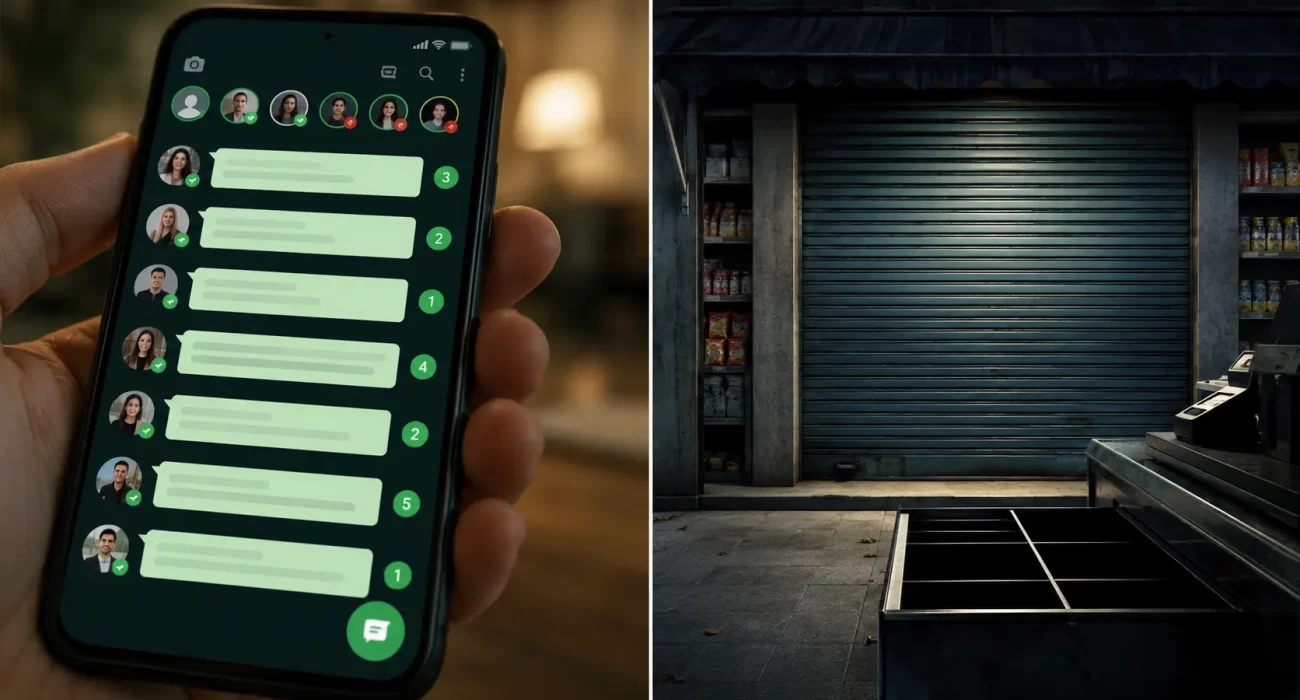
How many inquiries did you get last month? How many did you actually close? The gap between those two numbers is your biggest problem.
Let me tell you about a conversation I had with a local business owner in Kolkata not too long ago.
He runs a well-known interior design studio in South Kolkata. Beautiful work. Real craftsmanship. He’s been at it for over a decade. I asked him how his inquiries were going. He smiled and said, “Bohot aate hain. Bohot.” (So many come. So many.)
Then I asked: “Out of the last 20 inquiries, how many did you convert?”
He paused. Scratched his head. Said, “Maybe… 4? 5?”
That smile faded a little.
He wasn’t losing clients because his work was bad. He wasn’t losing them to cheaper competitors. He was losing them because by the time he got back to them — an hour later, a day later, sometimes two — they had already moved on. They had already booked someone else. Or worse: they had stopped looking altogether.
He wasn’t losing the sale. He was abandoning it.
And if you own or manage a local business in India right now, I’d bet money you recognise exactly what I’m describing.
The Invisible Revenue Leak That’s Killing Indian Local Businesses
This isn’t a story about bad marketing. This isn’t about not running enough ads or not having a good website. This is about what happens after the inquiry lands.
Here is the brutal truth:
On average, businesses take 47 hours to respond to a lead. That’s nearly two full days — two days for your competitor to plant the seeds of a strong relationship, or for your prospect’s excitement to simply die out.
And it gets worse:
Only 27% of leads ever get contacted at all.
Read that again. Nearly 3 out of every 4 inquiries go completely unanswered. These aren’t cold leads pulled from a database. These are real people who raised their hand and said, “I’m interested. Talk to me.”
In India, where WhatsApp is the beating heart of business communication, this problem is amplified in a way most business owners haven’t fully reckoned with yet.
India has over 530 million WhatsApp users — the highest of any country in the world. Your customers are on WhatsApp. Your inquiries are on WhatsApp. Your sales pipeline — whether you’ve formalised it or not — is on WhatsApp. (Source)
And it’s leaking.
What ₹50,000 Actually Looks Like When It Walks Out the Door
Let’s put a number to this. Not a vague “you’re losing money” statement — an actual, tangible scenario that might feel uncomfortably familiar.
The Leaking Funnel — A Typical Kolkata Local Business
| Stage | Number | What’s Happening |
|---|---|---|
| WhatsApp inquiries received / month | 25 | Real people, real intent |
| Inquiries responded to within 1 hour | 8 | The rest get buried or forgotten |
| Inquiries that received a follow-up | 4 | Most owners follow up once, then give up |
| Inquiries that converted to clients | 3 | The “natural” closures |
| Average deal value | ₹15,000–₹20,000 | Conservative estimate |
| Revenue lost from no follow-up | ₹50,000–₹80,000 | Every. Single. Month. |
This is not a hypothetical. A real-world analysis of a mid-size firm running digital campaigns showed that without a structured follow-up system, ₹50,000+ of marketing spend generated zero return — every single month. (Source)
You’re spending money on Google Ads, on social media posts, on a website — and then leaving the harvest rotting on the ground.
Why This Keeps Happening — And It’s Not Laziness
Here’s where I want to be honest with you, because most marketing agencies won’t say this:
It’s not your fault that this keeps happening. But it is your responsibility to fix it.
The reason most local business owners lose inquiries isn’t carelessness. It’s chaos. You’re wearing six hats at once. You’re the owner, the operations manager, the delivery team, and the sales team — sometimes simultaneously. Your WhatsApp is both your business line and the place where your family sends good morning messages.
In India, WhatsApp is the primary sales channel for small and medium businesses. Sales reps often manage customer chats on the same WhatsApp account as personal contacts — and lead messages get buried under family groups. (Source)
This is the quiet dysfunction that nobody talks about in those “how to grow your business” posts you see on Instagram.
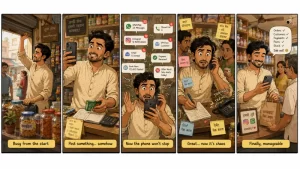
Here’s what the follow-up breakdown actually looks like for most Indian SMBs:
The 5 Stages of Losing a Lead (Without Realizing It)
- Stage 1 — The Inquiry Arrives: Someone messages you on WhatsApp. You see it. You’re in the middle of something. You think, “I’ll reply in 10 minutes.”
- Stage 2 — The Delay: 10 minutes becomes 2 hours. A family message, a delivery issue, a call — the notification disappears.
- Stage 3 — The Discovery: You find the message. You tell yourself you’ll reply after finishing what you’re doing.
- Stage 4 — The Intention: End of day. You see it again. You’re tired. You think, “I’ll reply fresh in the morning.”
- Stage 5 — The Silence: By morning, the moment is gone. And with it, the sale.
Nobody decided to lose that client. It just happened. Over and over again.
The Numbers That Should Make You Sit Up
I’m going to give you some statistics now. Not to overwhelm you — but because seeing the data laid out cleanly changes something in your brain. It turns a vague feeling of “I should probably follow up more” into the cold clarity of “I am actively losing money right now.”
The Speed-to-Lead Reality Check
| Response Time | Impact on Conversion |
|---|---|
| Under 5 minutes | Highest conversion probability — lead is still “hot” |
| 5–60 minutes | Conversion rate drops significantly |
| 1–24 hours | Your chances of a meaningful response drop to 24% after five days (Source) |
| After 47 hours | Average Indian business response time — almost all intent is lost |
| Never | 27% of leads are never contacted at all |
Sources: Forbes via Rep.ai, Peak Sales Recruiting
35–50% of all sales go to the vendor that responds first. Not the one with the best product. Not the most experienced one. Not even the cheapest one. The first one to show up. (Source)
Sales teams that follow up within the first hour are 7x more likely to qualify a lead compared to those who wait even an hour longer. (Source)
And yet — 48% of salespeople never make even a single follow-up call. Of those who do try, 44% give up after just one “no.” (Source)
Meanwhile, 80% of all sales are made after five to twelve contact attempts from a salesperson. (Source)
The gap between where most businesses operate and where the sales actually happen is staggering. And it’s entirely fixable.
WhatsApp Is a Gold Mine — But Only If You Treat It Like One
Let’s also address something: WhatsApp isn’t just a messenger app anymore. It is India’s business infrastructure.
WhatsApp messages achieve open rates of 95-98%, compared to just 20–25% for email. Think about that. When you send a WhatsApp message to a prospect, nearly every single one of them will read it. (Source)
WhatsApp messages are read within 5 minutes by around 80% of users. (Source)
WhatsApp Business has the highest conversion rate of 45–60% when businesses use the platform effectively — compared to 2–5% for email and SMS. (Source)
66% of users have made a purchase after communicating with a brand on WhatsApp. 69% of consumers say they are more likely to buy from a brand if there’s a WhatsApp option available. (Source)
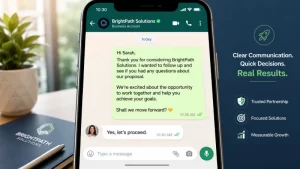
This is the platform where your customers want to be reached. They’re already there, waiting for you to show up like a professional.
The question isn’t whether WhatsApp works. It does — spectacularly. The question is whether you are using it with intention, or just reacting to it among everything else you’re doing.
What a Simple Follow-Up System Actually Looks Like
This is the part most marketing content skips. Everyone tells you “follow up more!” but nobody actually explains what that looks like in practice for a local business owner in Kolkata who doesn’t have a sales team.
Here’s a no-jargon framework. I call it the 3-Touch Follow-Up System — simple enough to implement this week, powerful enough to measurably improve your conversion rate.
The 3-Touch Follow-Up System for Indian Local Businesses
| Touch | Timing | What to Say | Channel |
|---|---|---|---|
| Touch 1 | Within 30 minutes of inquiry | Acknowledge, set expectations (“Saw your message! Will call you in X minutes to discuss.”) | |
| Touch 2 | 24 hours later (if no response) | Add value — share a relevant photo, a past project, a quick answer to their likely question | |
| Touch 3 | 3–4 days later | Gentle re-engagement (“Still looking for [service]? Happy to help whenever you’re ready.”) | WhatsApp or Call |
Key principles that make this work:
- Speed beats perfection. A fast, imperfect reply beats a slow, polished one every time. Acknowledge first, elaborate second.
- Personalize minimally but meaningfully. Use their name. Reference what they asked about. Two sentences of personalization change everything.
- Remove yourself from the bottleneck. If you can’t reply within 30 minutes personally, set up a WhatsApp Business auto-reply that acknowledges them and sets a time expectation.
- Don’t give up after one attempt. Most owners follow up once. 80% of sales happen between the fifth and twelfth contact. One attempt isn’t a follow-up system — it’s a formality. (Source)
The Mindset Shift That Changes Everything
I want to say something that might sting a little.
Most local business owners think their job ends when the customer reaches out. “They came to me — now it’s their move.” This mindset is costing you real money, real growth, real opportunity.
The businesses that are growing quietly — the boutique gym that’s always full, the home renovation contractor with a three-month waiting list, the CA firm that gets referrals every week — they all share one thing. They treat follow-up as a non-negotiable part of their business, not an optional courtesy.
Brands using WhatsApp for customer care saw a 40% higher repeat purchase rate than those using email. Not just first-time conversion — lifetime value. (Source)
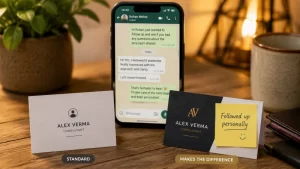
Your follow-up isn’t just about closing this one sale. It’s about demonstrating to a potential customer — before they’ve spent a single rupee — that you’re the kind of business that shows up. That you’re reliable, that’s when they have a problem; they can count on you.
That is how trust is built. Not in the project itself. In the moments before it starts.
The Action List — What to Do This Week
If this blog has done its job, you’re not looking for more information right now. You’re looking for the next step. Here it is:
Your 5-Step Follow-Up Audit (Do This Today)
- Count your last 30 days of inquiries. WhatsApp, Instagram DMs, Google calls, walk-ins — all of it. Write the number down.
- Count how many you actually followed up with more than once. Be honest. No judgment.
- Calculate your conversion rate. Closures ÷ Total Inquiries × 100. Most local businesses, when they do this for the first time, see a number between 10–20%. It should be 30–50%.
- Set up a WhatsApp Business auto-reply. If you haven’t already, do it today. Even “Thanks for reaching out! I’ll respond within the hour” buys you time and builds trust.
- Pick 5 old inquiries from the last 3 months that went cold. Message them today. Don’t pitch. Just check in: “Hi [Name], you’d reached out earlier about [service]. I wanted to check if you’re still looking — happy to help if so.” You will be surprised by how many respond.
This doesn’t require a CRM. It doesn’t require a sales team. It requires about 20 minutes, and the decision to take your follow-up seriously.
The Bigger Picture — Systems Beat Willpower Every Time
Here’s the honest thing I want to leave you with:
You don’t have a motivation problem. You don’t need another productivity hack. What most local businesses are missing is a system — a simple, repeatable process that works even when you’re busy, tired, or distracted.
According to a 2024 NASSCOM survey, 62% of Indian SMB sales teams still rely on spreadsheets or manual methods for lead tracking — directly causing lower conversion rates. Businesses that implemented proper systems reported a 34% increase in sales productivity and a 48% reduction in lead response time. (Source)
That’s the difference between growing and stagnating. Not talent. Not even a budget. Systems.
When Sandora Digital works with local businesses, this is where we start — not with ads, not with fancy content, but with the foundational question: what happens to a customer after they show interest? Because if that answer is “not much,” every rupee spent on marketing is a rupee that’s partially wasted.
You deserve to see a return on the time and money you’re already putting in. Your inquiries are already coming. The customers are already interested.
All that’s missing is the follow-through.
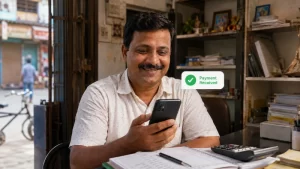
Final Thought — The Inquiry Was the Easy Part
Someone took time out of their day to message you. They looked you up. They chose to reach out to you — out of everyone else they could have contacted. That’s not a small thing.
Don’t make them wait two days for you to respond. Don’t make them follow up with you to ask if you got their message. Don’t let them walk quietly into a competitor’s inbox while you’re still meaning to reply.
The ₹50,000 isn’t lost to bad marketing. It’s lost to silence.
And silence, thankfully, is the easiest thing in the world to fix.
We help local businesses in Kolkata and across India build marketing systems — not just campaigns. If you’re losing inquiries and you’re not sure where the gap is, contact us. Let’s map it out.