

A parent in Salt Lake searching “best NEET coaching near me” isn’t going to scroll past three pages of results to find you. If your centre isn’t showing up in that first local pack, you’re invisible to the exact family that’s ready to enrol this admission cycle — and no amount of banner ads on the road outside your building fixes that. Local SEO does, and unlike ads, it keeps working after you stop paying for it.
Local SEO fills coaching seats by making your centre the result that appears when a parent in your locality searches “NEET coaching near me” or “class 10 tuition in Behala.” Five moves do most of the work: a fully built Google Business Profile, one landing page per area you serve, a steady flow of genuine reviews, parent-question content marked up with schema, and identical NAP details across local directories. Expect early visibility gains in 2–4 weeks and a dependable enquiry channel in 4–6 months — with no cost per click.
Why Local SEO Beats Ads for a Coaching Centre
A coaching decision takes days, not seconds
Coaching decisions aren’t impulse buys. A parent checks three or four centres, reads reviews, asks other parents in the building group, and compares batch timings before committing — often over several days. Ads catch someone mid-scroll for a few seconds. A well-optimised Google Business Profile and a handful of area pages catch that same parent during every single one of those research sessions, at zero cost per click.
SEO compounds; ads reset to zero
An ad stops the moment your budget runs out. A local listing with 80 genuine reviews and a page ranking for “spoken English classes Gariahat” keeps bringing enquiries in March, in July, and again next admission season — without a fresh rupee spent each time. That is the core difference: with ads you rent attention, with local SEO you own it.
| Factor | Google Ads | Local SEO |
|---|---|---|
| Time to first enquiry | Same day | 2–6 weeks |
| Cost per enquiry over time | Flat or rising | Falls every month |
| What happens when you stop | Enquiries stop instantly | Rankings hold for months |
| Trust signal for parents | Marked “Sponsored” | Reviews, photos, proof |
| Best used for | Filling a batch starting in 2 weeks | Filling every batch after that |
Step 1: Fix Your Google Business Profile First
This is the single biggest lever, and most coaching centres get at least one part of it wrong. Your Google Business Profile is what feeds the map pack, the “near me” results, and increasingly the AI-generated answers parents see before they ever reach a website. Start here before touching anything else.
The five GBP fixes that move rankings
- Choose the most specific category. Tutoring Service, Test Preparation Centre, or Language School — not the generic “Educational Institution.” Category match directly drives which searches you appear for.
- List every subject and batch as a service. “Class 10 ICSE Maths,” “NEET Biology Crash Course,” and “Spoken English — Adults” each get indexed separately instead of being buried in your description.
- Upload real photos every month. Classroom, faculty, results boards, batch groups. Profiles with fresh, genuine photos earn far more clicks than ones with a logo and nothing else.
- Post results and enrollment updates. “Batch 12 NEET results: 6 students above 650” is exactly the kind of specific, quotable proof that ranks and converts.
If your profile still isn’t showing after all of this, the cause is usually one of a handful of fixable issues — our breakdown of why Google sends customers to your competitor instead walks through each one. Centres with multiple branches need a separate verified profile per location, never one listing with a “branches” note in the description.
Step 2: Build Area-Specific Pages, Not One Generic “About Us”
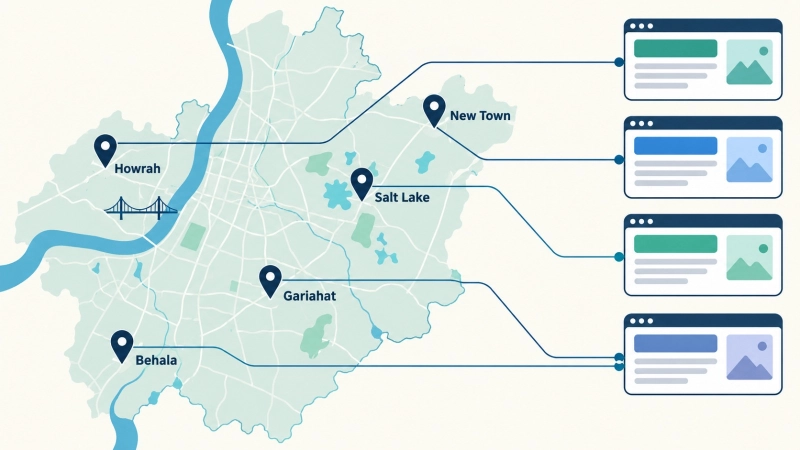
Ranking for “coaching centre Kolkata” as a single broad term is close to impossible for an independent centre competing against citywide chains. Ranking for “JEE coaching in Behala” or “class 12 boards tuition New Town” is genuinely achievable — and it mirrors how a Gariahat parent and a Salt Lake parent actually search for the same service.
How to structure area and subject pages
Build one page per neighbourhood you genuinely serve, each with real, non-duplicated content: nearest landmarks and transport, batch timings for that branch or catchment, faculty who teach there, and testimonials from students in that area. Copy-pasting one template and swapping the locality name is the fastest way to get the whole set ignored.
- Area pages: /neet-coaching-salt-lake/, /jee-coaching-behala/, /tuition-classes-new-town/
- Subject pages: /neet-coaching/, /wbjee-coaching/, /class-10-icse-tuition/, /spoken-english-classes/
- Combination pages where search volume justifies it: /neet-coaching-gariahat/ as its own page, not a paragraph on the homepage.
This only works if your site can hold that structure without slowing to a crawl, which is why page speed and clean URLs belong in the website development brief, not after it.
Step 3: Reviews Are Your Ranking Fuel
Google folds review count, recency, and rating directly into local rankings — and parents weigh them even more heavily than Google does. A centre with 60 recent reviews will routinely outrank a better-known one sitting on 11 reviews from 2022.
Ask at the moment satisfaction peaks
Ask right after a result announcement or a strong admission-test performance, when satisfaction is highest and the request feels natural rather than transactional. Keep a short link or QR code at the front desk and make asking part of the result-day routine, not a one-off campaign.
Reply to everything — and never buy reviews
Respond to every review in plain language — not a copy-pasted “Thank you for your feedback.” A thoughtful reply to a 3-star review about batch size often does more for trust than another silent 5-star. Never buy reviews or trade fee discounts for them: Google prohibits incentivised reviews, and centres caught doing it can lose their entire review history overnight.
Step 4: Content That Gets Read, Ranks, and Gets Quoted by AI
Skip generic “why choose us” blog posts. Publish what parents are actually typing into Google: exam date reminders, “class 10 ICSE vs CBSE Kolkata” comparisons, “when should my child start NEET coaching,” or a results page after every batch.
Writing for answer engines (AEO) and AI search (GEO)
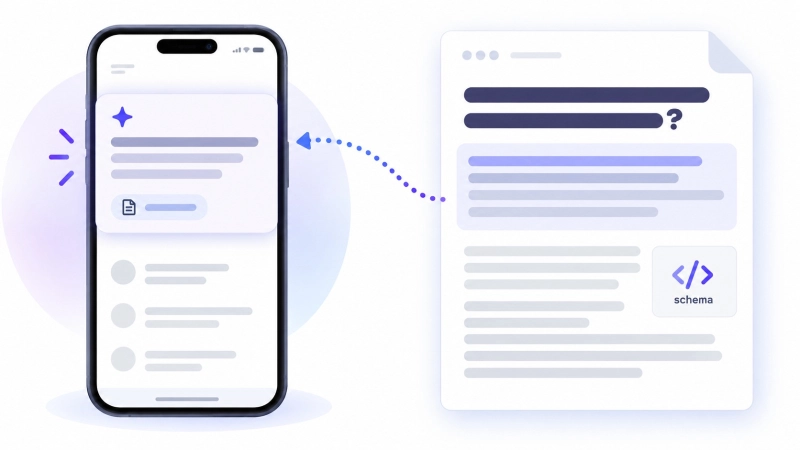
Search no longer ends at ten blue links. Google’s AI Overviews, ChatGPT and Perplexity now answer the parent’s question directly and cite a few sources — and they pull from pages that state answers plainly. Three habits make your content quotable:
- Lead with the answer. Put a 40–60 word direct answer immediately under each question heading, then explain underneath.
- Use question-shaped headings. “How much does NEET coaching cost in Kolkata?” beats “Our Fee Structure.”
- Be specific and dated. Numbers, localities, batch sizes and years give AI systems something concrete to cite; vague claims get skipped.
If you want the fuller picture of how this shift is playing out locally, read our guide to what AI Overviews mean for Kolkata businesses, and see how a proper content marketing calendar keeps this running past the first month.
Add schema so machines can read your pages
Add Course and LocalBusiness schema to your key pages, and FAQPage schema to any page answering common parent questions. Schema is how you tell Google the numbers on your page are fees, the names are subjects, and the timings are batch schedules. None of this needs a developer — most of it can be added through a plugin or a template update, and our explainer on how schema boosts local visibility covers the exact types to use.
Step 5: Citations and Local Directories
Beyond Google, list your centre consistently on Justdial, Sulekha, UrbanPro, IndiaMART and any Kolkata-specific education directories relevant to your subjects. “Consistently” is the operative word — your name, address, and phone number should match character-for-character across every listing, right down to whether you write “Road” or “Rd.” A mismatched address on even one directory is enough to slow how much Google trusts your primary listing.
Re-sweep every six months, especially after a change of floor or phone number. Old listings with a dead landline quietly leak enquiries for years.
Don’t Let the Enquiries Leak After They Arrive
Ranking is only half the job. Most centres lose more admissions to slow follow-up than to poor visibility — a parent who WhatsApps at 9 PM and hears back two days later has already booked a demo elsewhere. Fix the response loop before you scale the traffic, as we explained in why WhatsApp enquiries quietly cost businesses lakhs.
A 90-Day Local SEO Plan for a Coaching Centre
| Phase | Focus | What to Do |
|---|---|---|
| Month 1 | Foundation | Fix GBP category, services, photos and Q&A; claim and correct citations across directories; audit NAP consistency |
| Month 2 | Local pages & reviews | Publish area-wise landing pages; launch a weekly review-request habit tied to result days |
| Month 3 | Content & schema | Publish 4–6 parent-question articles; add Course, LocalBusiness and FAQ schema; start tracking enquiry sources |
How to Tell Whether It’s Actually Working
Rankings alone are a vanity metric. Track four things monthly, and judge the channel on the trend rather than any single week:
- GBP calls, direction requests and website clicks — available free inside your profile’s performance tab.
- Map pack position for your three most valuable searches, checked from inside your actual locality.
- Enquiry source — ask every caller how they found you and log it.
- Enquiry-to-admission rate, so you can tell a traffic problem apart from a follow-up problem.
What Local SEO Won’t Do
Be honest with yourself about the limits. If you need 20 seats filled in the next two weeks before a batch starts, local SEO won’t move fast enough on its own — that’s what a short, targeted Google Ads flight is actually for. Local SEO is the channel that fills the batch after that one, and the one after, without you having to keep paying each time. The two aren’t rivals: ads solve urgency, SEO solves the next five years. If you’re weighing which to start with, our comparison of SEO vs Google Ads for a new Kolkata business lays out the trade-off, and our local SEO pricing page shows what the ongoing work realistically costs.
Frequently Asked Questions
How long does local SEO take to fill seats for a coaching centre?
Google Business Profile fixes can lift local visibility within 2–4 weeks. Area pages and review volume typically take 2–3 months to show up in enquiries, and 4–6 months to become a channel you can plan batches around.
Do I need a website, or is a Google Business Profile enough?
A Google Business Profile alone can generate calls for a single-location centre, but it caps how many neighbourhoods and subjects you can rank for. A website with area and subject-specific pages is what lets you show up for searches beyond your immediate locality.
Is buying Google reviews a good shortcut?
No. Google’s review policies prohibit incentivised or fake reviews, and centres caught doing this risk having their entire review history wiped or their profile suspended. Asking real students for honest reviews after results or admission tests is the only approach that holds up.
Which Google Business Profile category should a coaching centre use?
Choose the most specific category available — Tutoring Service, Test Preparation Centre, or Language School — rather than the generic Educational Institution. Google matches queries to categories directly, so specificity decides which searches you appear for.
Can local SEO work for a coaching centre with multiple branches in Kolkata?
Yes, and it works better than a single generic listing. Each branch needs its own verified Google Business Profile and its own localised landing page, so a search for coaching in Salt Lake surfaces the Salt Lake branch rather than a head office listing across the city.
How much does local SEO cost for a coaching centre in Kolkata?
It varies with the number of branches, subjects and localities covered — a single-location centre needs far less than a five-branch network. Our SEO cost breakdown for Kolkata businesses explains what drives the number so you can judge a quote fairly.
Does local SEO help my centre appear in AI search results?
Yes. AI Overviews and assistants like ChatGPT lean on structured, consistent local data — your profile, reviews, schema and citations. A centre with clean data and clear question-led pages is far likelier to be named when a parent asks an AI which coaching centres are good in their area.
Get Your Free Local SEO Audit
Every coaching centre’s biggest local SEO gaps are different — sometimes it’s the Google Business Profile category, sometimes it’s zero area coverage beyond one neighbourhood. Sandora Digital works with coaching and education brands across Kolkata, and our free audit identifies exactly what’s holding your centre back from local search — delivered within 24 hours, no obligation. Request your free audit here.