
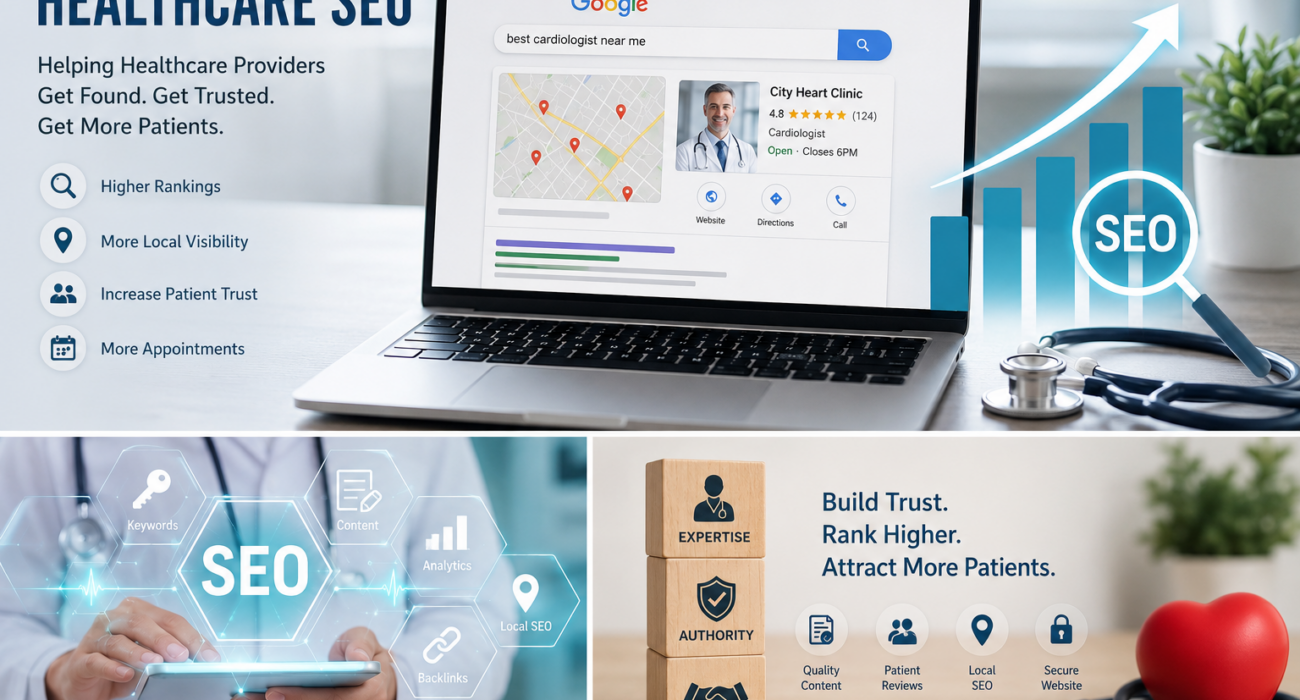
Thousands of people turn to Google every single day searching for things like “dentist near me,” “best orthopaedic doctor,” or “skin clinic in my area.” If your practice isn’t showing up when those searches happen, you’re handing patients straight to a competitor.
That’s the entire point of Healthcare SEO. Rather than leaning on referrals or paid ads to do all the heavy lifting, it puts your clinic in front of people at the exact moment they’re looking for treatment. Whether you’re running a dental practice, a physiotherapy centre, a diagnostic lab, or a multi-specialty hospital, a solid SEO strategy translates directly into more visibility and more booked appointments.
Below, we’ve broken this down into a question-and-answer format, covering the questions patients and practice owners actually ask, so you can find exactly what you need without wading through fluff.
What is Healthcare SEO?
Healthcare SEO is the process of optimising a medical website so it ranks higher on search engines when people search for healthcare services. It blends technical fixes, quality content, local optimisation, and trust signals to bring in patients who are actively looking for what you offer, organically, without paying for every single click.
Medical SEO differs from general SEO in one important way: accuracy and credibility carry far more weight. Healthcare decisions affect people’s lives, so Google holds these websites to a higher standard when it comes to demonstrating real expertise.
A properly optimised healthcare website should let patients:
- Find your services without digging through five pages
- Understand your specialties at a glance
- Trust that you know what you’re talking about
- Book an appointment in a couple of clicks
Why does Healthcare SEO matter more in 2026 than it used to?
Because almost every patient now starts their healthcare journey with a search, not a phone call. Before they ever contact a clinic, they’re comparing websites, reading reviews, checking symptoms, and shortlisting nearby providers. If your site answers their questions clearly and ranks well while doing it, you’re the one who earns their trust first.
The payoff compounds over time too:
- Steady organic traffic that doesn’t disappear when you pause ad spend
- Lower marketing costs the longer you invest
- Higher-quality leads, since people arrive already informed
- Stronger brand credibility
- Better long-term ROI than paid advertising alone
How does keyword research help doctors reach the right patients?
Keyword research works by matching your website’s content to the exact phrases patients type into Google, focusing on intent rather than raw search volume. A broad term like “doctor” tells Google almost nothing about what you actually treat. Specific phrases do the heavy lifting instead:
- Paediatrician in Kolkata
- Best dental clinic near me
- Sports injury physiotherapist
- Diabetes specialist consultation
Weaving these naturally into your site helps Google (and your future patients) understand exactly what you do and who you do it for. This is genuinely the foundation everything else in SEO for doctors is built on.
Why does high-quality medical content matter for rankings?
Because accurate, patient-focused content builds trust with both real visitors and search engines at the same time. Most patients research a condition before they ever book a consultation, so content that actually helps them gets rewarded twice: once by the reader, once by the algorithm.
Worth writing about:
- Symptoms
- Treatment options
- Recovery timelines
- Preventive care
- Common patient questions
Good medical content should:
- Use plain, everyday language
- Stay medically accurate
- Skip unnecessary jargon
- Reflect current, updated information
- Point readers toward a professional consultation rather than replacing one
How does on-page SEO improve a healthcare website?
On-page SEO helps search engines and real visitors understand what each page on your site is actually about, and small, consistent tweaks add up to significant ranking gains over time. Focus areas include:
- Clear, specific page titles
- Well-written meta descriptions
- Logical heading structure
- Internal links between related pages
- Optimised images
- Fast page load times
Every service page should stick to one core topic. A dental implants page trying to also rank for teeth whitening, root canals, and orthodontics will usually rank for none of them well.
Why is local SEO essential for clinics?
Because most healthcare searches carry local intent, meaning patients are almost always looking for a provider close to home, not the “best in the world.” Someone searching for a dentist wants one they can actually get to.
To strengthen local visibility:
- Keep your business details consistent everywhere online
- List accurate, current clinic hours
- Add recent photos of your clinic
- Actively collect patient reviews
- Build out location-specific service pages
Strong Clinic SEO is what puts your practice in front of patients who are ready to book right now, not just browsing.
How do patient reviews affect search rankings?
Reviews act as a trust signal to Google and, honestly, they influence a patient’s decision more than most advertising ever will. Encourage happy patients to leave honest feedback after a good experience, and don’t ignore the process once reviews start coming in.
When responding to reviews:
- Thank patients professionally
- Never break patient confidentiality
- Respond to negative feedback calmly and politely
- Show that you’re genuinely willing to improve
Authentic, well-handled reviews build both search visibility and real patient confidence.
What technical SEO issues should healthcare websites fix?
Technical SEO makes sure search engines can crawl your site properly while visitors get a smooth, frustration-free experience. Common culprits worth checking today:
- Slow loading speed
- Broken links
- Mobile usability problems
- Missing HTTPS security
- Duplicate pages
- Confusing navigation
Healthcare sites tend to accumulate a lot of service pages over the years. Keeping them organised makes life easier for patients and for Google, in that order.
Why is mobile optimisation no longer optional?
Because the majority of healthcare searches now happen on a phone, and a clunky mobile site will lose patients before they even reach your booking form. A genuinely mobile-friendly site needs:
- Fast loading on mobile networks
- Text that’s actually readable without zooming
- Clickable phone numbers
- A simple, short appointment form
- Straightforward navigation
Google also factors mobile performance directly into how it ranks your site, so this isn’t just a user experience issue, it’s an SEO one too.
How can healthcare websites build trust with Google?
Google specifically rewards healthcare sites that show real expertise, experience, authority, and trustworthiness (often shortened to E-E-A-T). Ways to build that credibility:
- Publish detailed doctor profiles
- Display qualifications clearly
- Show clinic certifications
- Include genuine patient testimonials
- Keep medical information current
None of this happens overnight, but consistent, honest quality compounds into strong long-term rankings.
Should clinics regularly update their website?
Yes. Fresh content tells Google your practice is active, and it opens up new opportunities to rank for additional searches. Content worth adding regularly:
- New treatment methods
- Seasonal healthcare advice
- Preventive care tips
- Frequently asked patient questions
- Clinic announcements
- Patient success stories (with permission)
Regular publishing supports your broader Healthcare digital marketing strategy while giving returning visitors a reason to come back.
How do you measure whether Healthcare SEO is actually working?
By tracking metrics tied to real patients, not just raw traffic numbers. Worth watching:
- Organic traffic growth
- Keyword rankings
- Appointment requests
- Phone calls generated
- Google Business Profile interactions
- Conversion rate
- Bounce rate
Traffic that never converts isn’t much use to anyone. The real question is how many visitors turn into actual patients.
Final Word
Referrals and traditional advertising alone can’t carry a healthcare practice through 2026. Patients now research symptoms, compare clinics, read reviews, and evaluate providers online long before they ever pick up the phone. A well-built Healthcare SEO strategy puts your practice in front of them during exactly those decision-making moments.
By focusing on strong content, local visibility, technical health, and genuine patient trust, clinics can steadily grow qualified traffic and appointment bookings while building a reputation that lasts. If you’re ready to strengthen your healthcare website’s search performance with ethical, results-driven Healthcare SEO services, Sandora Digital can build a strategy tailored to your practice and its long-term growth.